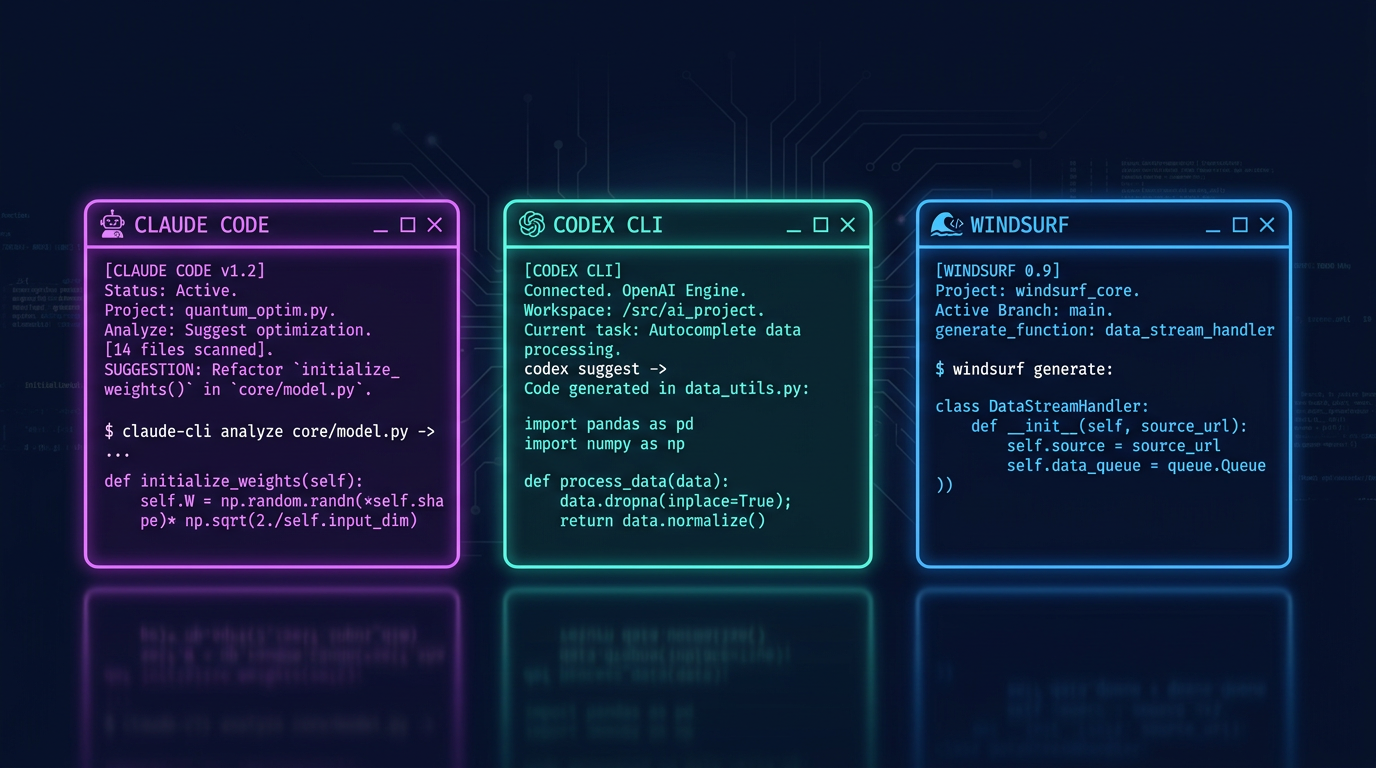
Terminal-native AI coding agents are the fastest-growing category in developer tools. Claude Code, OpenAI Codex CLI, and Windsurf each take a different approach to the same problem: giving developers an AI agent that lives in the terminal.
But they're not interchangeable. Each has a distinct philosophy, different strengths, and — critically — different capability gaps. Here's how they compare and how to choose.
The Three Contenders
| Claude Code | Codex CLI | Windsurf | |
|---|---|---|---|
| Company | Anthropic | OpenAI | Windsurf (Codeium) |
| Model | Claude Sonnet 4 / Opus 4 | GPT-5.5 / GPT-5 | Custom + GPT |
| Interface | Terminal-native CLI | Terminal-native CLI | Terminal + IDE hybrid |
| Agent model | Autonomous, tool-calling agent | Sandboxed, task-based agent | Agentic IDE with terminal mode |
| Release | Feb 2025 (GA) | Apr 2026 | Ongoing |
| Pricing | Free / Pro $20 / Max $100-200 | $20/mo (included in ChatGPT Plus) | Free / Pro $15 / Teams $30 |
Claude Code: The Autonomous Agent
Philosophy: Claude Code treats the terminal as the primary interface. It's designed to operate autonomously — you give it a high-level task and it plans, executes, and iterates without step-by-step guidance.
Strengths: Deep reasoning, subagents for parallel work, the deepest MCP ecosystem, 200K token context window with Sonnet 4.
Weaknesses: No native capabilities beyond code (image, video, search all require external tools), configuration burden for multiple MCP servers, usage-based pricing can escalate at scale.
Codex CLI: The Sandboxed Task-Runner
Philosophy: Codex CLI treats the terminal as a sandbox. It focuses on executing discrete tasks in isolated cloud VMs — each session is a fresh environment.
Strengths: Sandbox isolation, flat $20/month pricing, cloud-native parallel task execution, tight GitHub integration.
Weaknesses: Ephemeral state (no context across sessions), newer MCP ecosystem, less comfortable with open-ended exploration vs well-defined tasks.
Windsurf: The Hybrid Agent
Philosophy: Windsurf bridges the IDE and terminal. It began as an AI-powered IDE and has added terminal agent capabilities. For developers who want agentic assistance inside their editor, not a separate terminal.
Strengths: Seamless IDE integration, multi-file Cascade mode, lower barrier to entry for visual-oriented developers, $15/month Pro pricing.
Weaknesses: Less autonomous than Claude Code, less mature MCP support, higher system resource usage (full IDE + agent).
Head-to-Head: Key Dimensions
Autonomy
| Claude Code | Codex CLI | Windsurf | |
|---|---|---|---|
| Multi-step planning | ⭐⭐⭐⭐⭐ | ⭐⭐⭐ | ⭐⭐ |
| Autonomous execution | ⭐⭐⭐⭐⭐ | ⭐⭐⭐ | ⭐⭐ |
| Subagent parallelism | ⭐⭐⭐⭐⭐ | ⭐⭐ | ⭐ |
Winner: Claude Code. For complex, multi-step tasks that need to run without supervision.
Ecosystem and Extensibility
| Claude Code | Codex CLI | Windsurf | |
|---|---|---|---|
| MCP support | ⭐⭐⭐⭐⭐ | ⭐⭐⭐ | ⭐⭐⭐ |
| Community tools | ⭐⭐⭐⭐⭐ | ⭐⭐ | ⭐⭐⭐ |
| Custom tool support | ⭐⭐⭐⭐⭐ | ⭐⭐⭐ | ⭐⭐⭐ |
Winner: Claude Code. Anthropic created MCP and the ecosystem reflects it.
Pricing and Accessibility
| Claude Code | Codex CLI | Windsurf | |
|---|---|---|---|
| Free tier | ✅ (with limits) | ❌ ($20/mo) | ✅ (limited) |
| Individual cost | $20-200/mo | $20/mo | $15/mo |
Winner: Codex CLI or Windsurf. Claude Code's usage-based pricing can escalate quickly.
Sandbox and Safety
| Claude Code | Codex CLI | Windsurf | |
|---|---|---|---|
| Ephemeral execution | ⭐⭐⭐ | ⭐⭐⭐⭐⭐ | ⭐⭐ |
| Permission model | ⭐⭐⭐⭐ | ⭐⭐⭐⭐ | ⭐⭐⭐ |
Winner: Codex CLI. Cloud sandbox model is inherently safer for automated workflows.
The Shared Weakness: What None of Them Can Do
All three agents share the same fundamental limitation: they can manipulate code and files, but they can't produce or perceive media, search the web with grounded results, store outputs in the cloud, or publish what they build.
This isn't a flaw in any individual agent. It's a gap in the agent architecture. The model layer handles reasoning. The agent framework handles the loop. But the capability layer — the tools for image generation, video, search, storage, and publishing — is left to the developer to assemble.
For all three agents, the fix is the same: add a capability runtime that bundles these five capabilities into one tool. One CLI command. One credential. Structured JSON output that any agent can parse.
Which One Should You Choose?
| Your workflow | Choose |
|---|---|
| Deep, autonomous coding sessions | Claude Code |
| CI/CD, automated pipelines, cloud-native | Codex CLI |
| IDE-integrated assistance, visual preference | Windsurf |
| Budget-conscious, flat pricing | Codex CLI or Windsurf |
| Maximum extensibility, MCP ecosystem | Claude Code |
There's no wrong choice — only the wrong fit for your workflow. And regardless of which you pick, you'll need the same capability layer to move beyond code-only tasks.
Last updated: May 2026
What to Read Next
- Claude Code Tutorial: Zero to First Working Session (2026) — complete setup guide for Claude Code with AnyCap integration
- Claude Code Agent SDK Guide (2026) — embed Claude Code agent behavior into your own applications
- OpenAI Codex CLI: The Complete Developer Guide (2026) — full Codex CLI setup, sandboxing, and capability extension
- How to Generate Images with Claude Code (2026) — add image generation to Claude Code
- OpenAI Codex Pricing (2026) — real costs, hidden fees, and how to save