Sheet Music Is Just Structured Data. Let Your Agent Handle It.
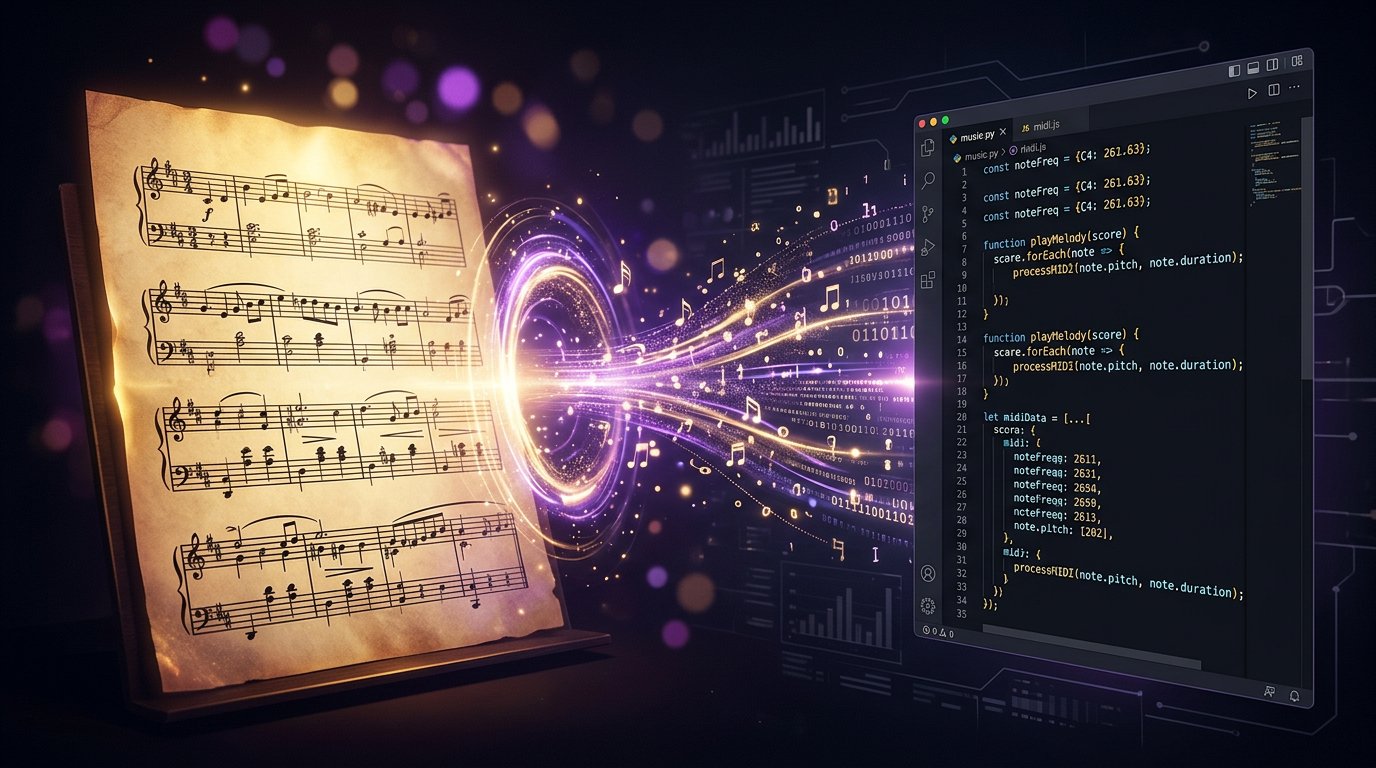
Musicians spend years learning to read and write notation. But from a developer's perspective, sheet music is structured data — notes on a grid, with timing, pitch, and velocity values. And structured data is exactly what AI agents excel at processing.
With AnyCap in Cursor, your agent can transcribe audio to sheet music, generate practice scores in bulk, convert between formats, and automate composition workflows that used to require specialized software and trained composers. Here's how.
The State of AI Music Composition
Traditional music notation tools are built for humans who know what they're doing:
| Tool | Type | Best For |
|---|---|---|
| MuseScore | Open-source notation | Full scores, community-driven |
| Sibelius | Professional notation | Orchestral, publishing-grade |
| Dorico | Modern notation engine | Complex contemporary scores |
| Noteflight | Web-based notation | Education, quick arrangements |
| ScoreCloud | AI-assisted transcription | Audio → notation conversion |
| AnthemScore | AI transcription | Automated audio-to-MIDI |
These tools are powerful. But they share the same workflow: open the app, create a new score, place notes one by one, export. When you need to generate sheet music for 100 exercises, or transcribe 20 audio files, or create arrangements for every instrument in a school band — the manual approach breaks down.
What AI Agents Can Automate
Audio-to-Notation Transcription
Feed an MP3 to your AnyCap agent and get sheet music back. The agent routes audio through a transcription model (like ScoreCloud or AnthemScore), then formats the output as MusicXML or PDF:
agent prompt: "transcribe this audio file to sheet music for piano, output as PDF"
→ agent: [processes audio → notation → exports Piano_Transcription.pdf]
The keyword is there ai that can transcribe music gets 1,600 monthly searches. People are looking for exactly this.
Batch Score Generation
Teachers, content creators, and educational platforms need hundreds of practice scores — scales, arpeggios, sight-reading exercises. An agent generates them all programmatically:
keys = ["C", "G", "D", "A", "E", "B", "F#", "Db", "Ab", "Eb", "Bb", "F"]
for key in keys:
    agent.generate_score(
        type="major_scale",
        key=key,
        instrument="piano",
        output=f"./exercises/{key}_major_scale.pdf"
    )
Twelve scales, twelve PDFs, zero manual note placement.
Format Conversion
MIDI to MusicXML. MusicXML to PDF. Audio to MIDI. Piano roll to sheet music. These conversions are tedious manual processes in notation software. An agent handles them as file transformations — read format A, write format B.
Multi-Instrument Arrangement
Given a melody, an agent can generate arrangements for any ensemble:
agent prompt: "take this piano melody and arrange it for string quartet"
→ agent outputs: violin_I.pdf, violin_II.pdf, viola.pdf, cello.pdf, full_score.pdf
An Agent-Driven Composition Pipeline
Here's a complete workflow that used to require three different tools and a trained musician:
- Input — Audio file of a melody (MP3, WAV, or even a phone recording)
- Transcription — Agent converts audio to MIDI via transcription model
- Cleaning — Agent quantizes timing, corrects obvious pitch errors
- Arrangement — Agent generates parts for target instruments
- Notation — Agent renders to MusicXML, then to PDF
- Delivery — Files land in your project folder, named and organized
All of this happens inside Cursor with AnyCap orchestrating each step. You describe the pipeline once, and the agent runs it on every file you drop in.
Why AnyCap for Composition Workflows
Standalone notation tools assume a human is driving. AnyCap assumes an agent is driving — and that changes the architecture:
| Task | Standalone Tool | AnyCap Agent |
|---|---|---|
| Transcribe 1 track | Open tool, import audio, wait, export | Agent processes in background |
| Transcribe 20 tracks | Repeat above 20 times | Agent loops through all 20 |
| Generate practice scores | Manually create each score | Agent generates from a template |
| Convert MIDI to PDF | Open MIDI in notation tool, print to PDF | Agent: read MIDI, write PDF |
| Arrange for ensemble | Manually create each part | Agent generates all parts |
The difference isn't capability — it's scale. One transcription is easy. Fifty is only easy if you have an agent.
Real Applications
Music education platforms use agent-driven composition to generate personalized exercise sheets for every student. A beginner gets C major scales. An advanced student gets chromatic exercises in odd meters. Both generated from the same agent template.
Content creators transcribe royalty-free audio to create sheet music for their audience. Upload a track, get notation, publish — all automated.
Game developers generate adaptive sheet music that changes based on player behavior. An agent monitors game state and outputs MusicXML that a renderer converts to live audio.
Get Started
Install AnyCap at anycap.ai/for, open Cursor, and try:
transcribe this audio to sheet music for piano, output as PDF
Your agent handles the transcription, notation, and export. The PDF appears in your project. No notation software required.
More: programmatic music generation for developers | 8-bit music with AI agents | AI music APIs compared