Use Cases
By AnyCap Team · Last updated April 7, 2026
Turn your agent into a
SMART goal generator
If you already work through Codex, Cursor, or Claude Code, you do not need a shallow web form that spits out generic goals. You need a workflow that lets your agent research examples, inspect source pages, and write SMART goals with better context. That is the role AnyCap plays.
Answer-first summary
A useful SMART goal generator does not stop at rewriting your prompt. It should produce one clear goal statement, one primary KPI, a baseline, a target, and a milestone plan. AnyCap improves that workflow by giving your agent live grounded search, web crawl, and publishing workflows, so the final goal can be researched, structured, shared, and reused.
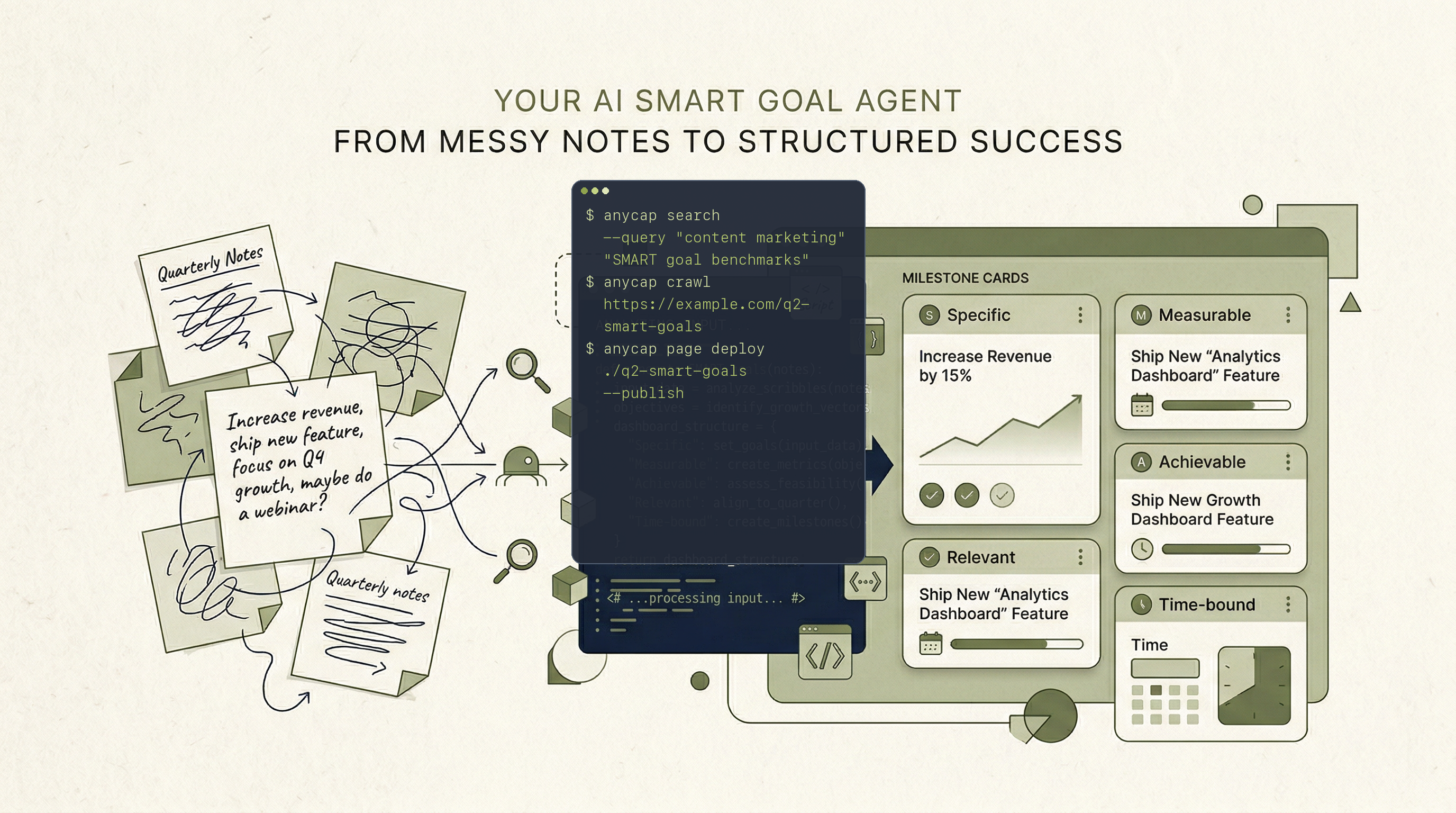
Example workflow
User: "Write SMART goals for my Q2 content marketing plan."
Agent: search for role-specific examples and benchmarks
Agent: crawl the strongest source pages into structured notes
Agent: draft SMART goals, KPIs, milestones, and action steps
Agent: save or publish the final brief through AnyCap
Quick answer
A strong SMART goal generator should do more than rewrite your prompt. It should help you move from a rough intention to a specific outcome, measurable KPIs, realistic constraints, and a deadline that fits the actual job. That is why generic AI goal writers often feel thin. They usually do not gather outside context first.
With AnyCap, your agent can search, crawl, structure, and publish. The result is not just a nicer sentence. It is a better-researched goal brief.
That distinction matters because searchers looking for a smart goal generator usually want more than a definition. They want something they can use in a review, a team brief, or a quarterly plan right away. To satisfy that intent, the output has to include constraints, metrics, and a realistic execution path, not just a polished sentence.
What makes a goal actually SMART
Specific
State the outcome, the scope, and who owns it. Vague goals like 'grow content' are too loose for real execution.
Measurable
Pick one primary KPI and a small set of supporting metrics so progress is visible and reviewable every week.
Achievable
The target has to fit your team, baseline, and quarter. A goal that needs perfect conditions is not truly achievable.
Relevant
A strong goal connects to a bigger priority such as pipeline growth, activation, retention, or launch readiness.
Time-bound
A deadline alone is not enough. Good SMART goals also define milestones inside the quarter so the work does not pile up at the end.
This framing is consistent with widely used SMART goal references from Stanford, Asana, and Atlassian, all of which emphasize clarity, measurement, and a defined timeframe rather than vague ambition alone.
What a deep research SMART goal writer looks like
Ask your agent for the outcome
Start with a plain-language request like a quarterly plan, role goal, or performance review objective.
Use AnyCap search for examples
Let the agent search for strong SMART goal examples, benchmarks, and role-specific success metrics before drafting anything.
Crawl useful source pages into notes
Turn the best pages into clean Markdown so the agent can compare patterns, extract language, and keep the research grounded.
Write goals, KPIs, and milestones
From there, the agent can draft SMART goals, define measurement criteria, and attach milestones and action steps.
Publish or share the result
Save templates to Drive or publish the final brief through Page so the plan is easy to review, share, and reuse.
Before research vs after research
Before
Rough request
“Grow our Q2 content program, get more newsletter subscribers, and make the team more consistent.”
This is directionally useful, but it has no baseline, no target, no owner logic, and no milestone structure.
After
Research-backed SMART goal
“By June 30, increase newsletter subscribers by 25% from the current baseline of 8,400 to 10,500 by publishing eight high-intent SEO articles, shipping one weekly newsletter, and refreshing five underperforming pages. Review progress every Friday using subscriber growth, article output, and assisted signup rate.”
What the agent should research before it writes
- Role-specific SMART goal examples from credible teams and operators
- Benchmarks for newsletter growth, content output, or campaign performance
- Quarterly planning templates that show how milestones and review cadence are usually structured
- Existing internal constraints such as headcount, channel mix, and current baseline performance
In practice, this is where AnyCap is better aligned than a generic tool page. A coding agent can run the retrieval loop first, then draft the final goal. If you need the full setup path, the fastest entry point is still the install guide.
Better than a one-shot generator
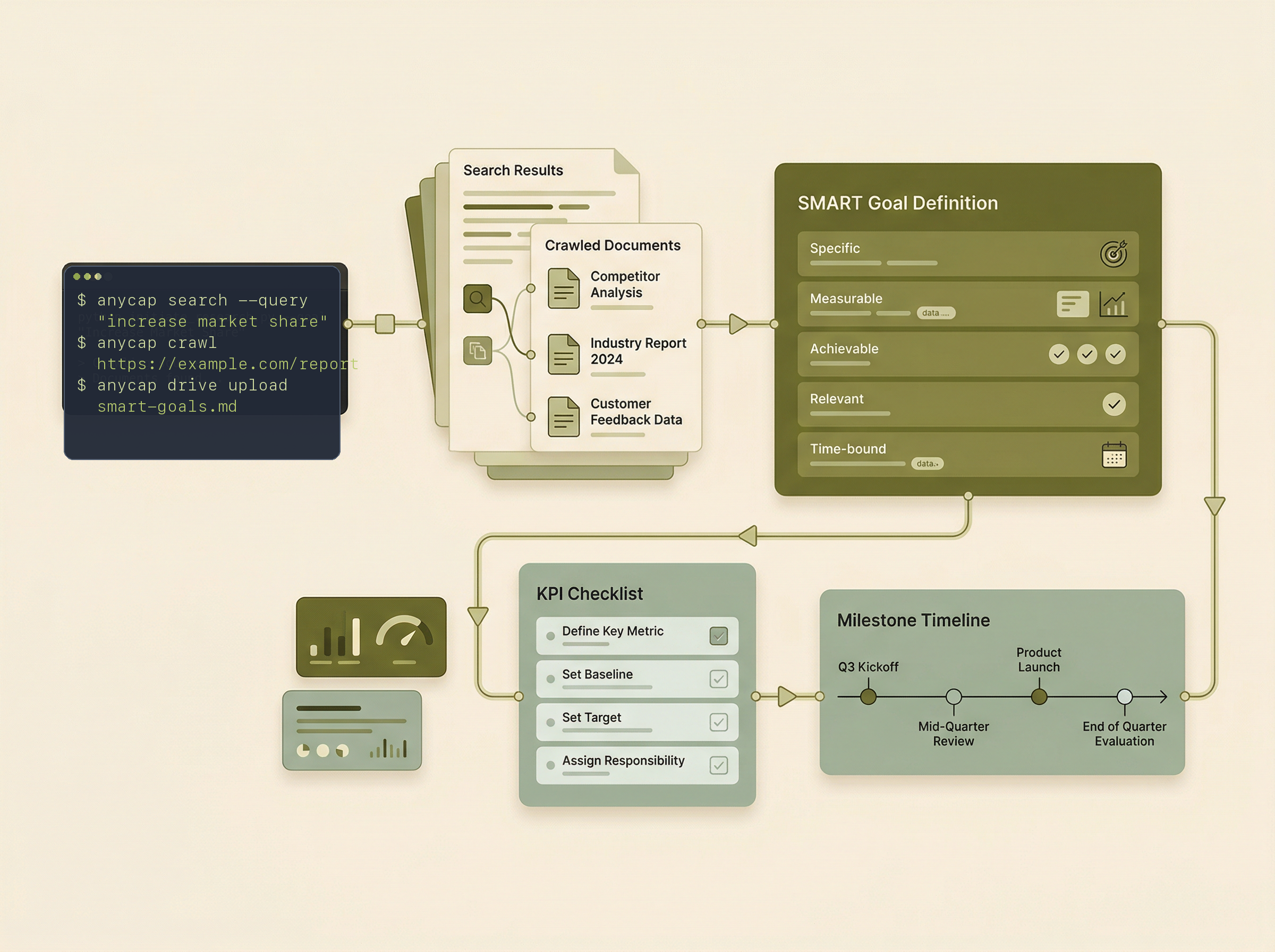
Example output
Goal: increase newsletter subscribers by 25% by June 30
KPI: subscribers, assisted signup rate, article output
Milestone 1: baseline audit and content calendar by week 2
Milestone 2: four articles and four newsletters by mid-quarter
Milestone 3: refresh five legacy pages before quarter end
Founder planning
Turn a rough Q2 growth target into a SMART goal with measurable traffic, conversion, and content production milestones.
Marketing execution
Generate role-specific goals for newsletter growth, SEO traffic, or campaign output using examples pulled from live sources.
Operator workflows
Draft goals that include realistic constraints, owners, review cadence, and team-ready action plans instead of generic platitudes.
This is the real difference between a one-shot generator and a deep-research workflow. The goal is no longer isolated from the work. It is connected to measurable progress, realistic sequencing, and a shareable artifact your team can actually review.
Use it with the agent you already have
Codex
Use AnyCap to give Codex grounded search, web crawl, and delivery capabilities around your planning workflow.
Cursor
Equip Cursor to research examples, compare source pages, and output a shareable SMART goal brief through one runtime.
Claude Code
Keep Claude Code as the agent you already use and add the capability layer it needs for deep research goal writing.
If your workflow already lives inside one of those tools, the product fit is stronger than using a disconnected generator page. Your agent can keep the context of the repo, the planning document, the campaign brief, and the retrieval loop in one working surface.
Sources and further reading
Stanford SMART goals worksheet
Used for the specificity, measurability, and time-bound framing in the guidance above.
Asana guide to SMART goals
Used as a practical reference for structuring measurable goals and review cadence.
Atlassian quarterly planning playbook
Used as a planning reference for quarterly cadence and milestone structure.
Role-specific SMART goal examples
Founder
A founder usually needs goals tied to growth, revenue, activation, or launch readiness. The agent should research market benchmarks first so the target is ambitious without becoming fantasy planning.
Marketer
A marketer often needs one goal tied to output and another tied to outcome. A good SMART goal should separate activity metrics from business KPIs instead of mashing everything into one vanity target.
Operator
Operators need milestones, owners, and review cadence. That is where a deep research workflow matters most, because implementation details are often more important than the headline metric.
When this workflow is a better fit than a generic tool
If you want a fast sentence and nothing more, a generic generator may be enough. But if you need a goal that survives contact with reality, the better path is to let an agent gather context first. That is especially true when the goal needs to align with a quarter plan, a team baseline, or an existing content strategy.
This page is therefore best for users who already work in agent-first tools and want a repeatable planning workflow rather than a disposable prompt toy. In that context, AnyCap is not replacing the agent. It is making the agent more useful by adding the retrieval and delivery layer around the writing step.
FAQ
Is this a normal web form SMART goal generator?
No. This workflow is for people who already use an AI agent like Codex, Cursor, or Claude Code. The agent handles the writing, while AnyCap gives it grounded search, crawl, storage, and publishing capabilities.
Why is this better than a generic AI goal writer?
Generic generators often produce shallow goals because they work from a short prompt alone. With AnyCap, your agent can search for real examples, crawl source pages into notes, and then write goals with better context, metrics, and constraints.
What parts does AnyCap handle in this workflow?
AnyCap handles the capability layer around the agent: search, grounded search, crawl, drive, and page publishing. The agent decides how to use those capabilities to research, structure, and deliver the final SMART goals.
Which agent is this best for?
The workflow fits Codex, Cursor, and Claude Code because all three can work from natural-language instructions and benefit from a stable capability runtime for web retrieval and output delivery.