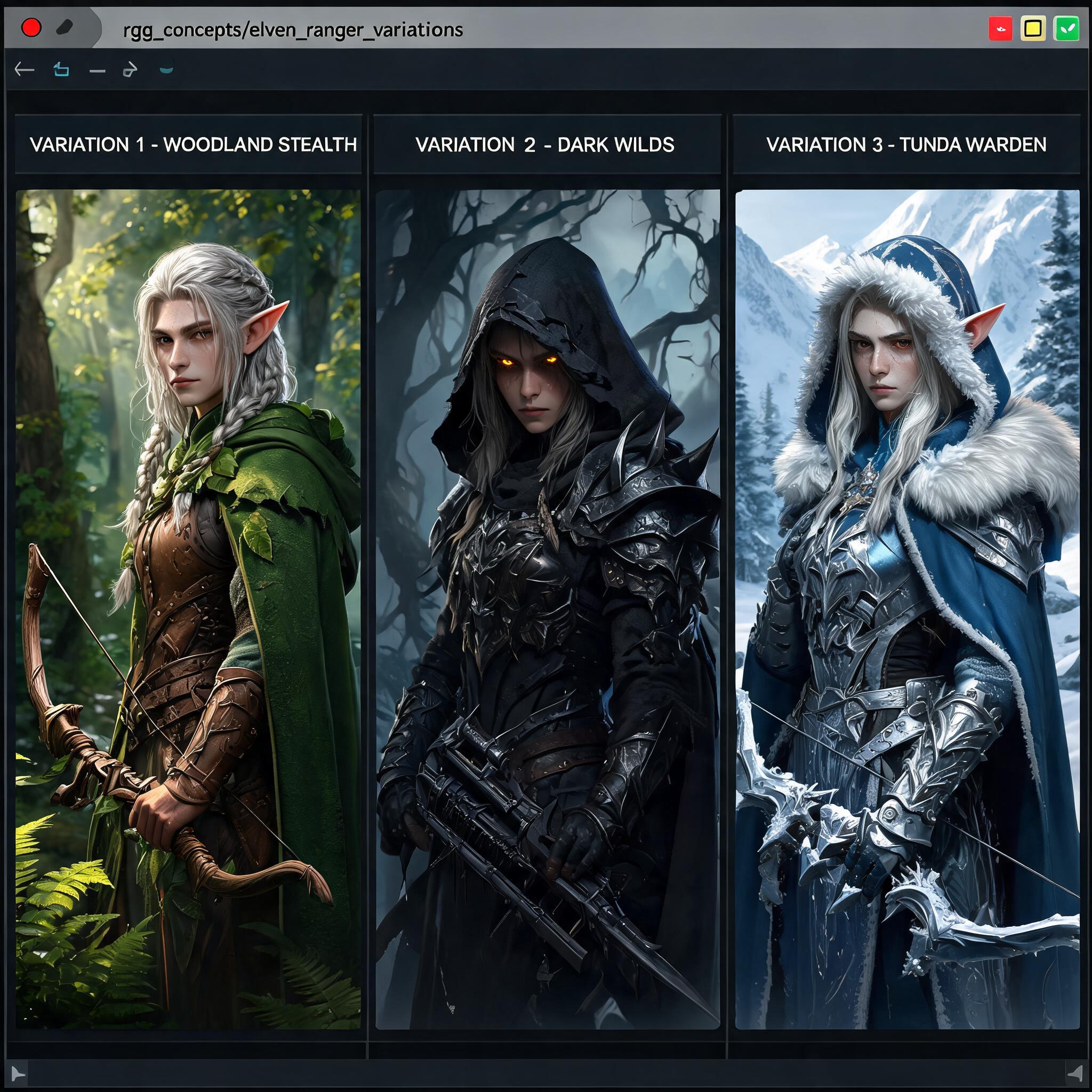
Every "best AI character generator" article shows you Canva, Midjourney, and Character.AI. They're written for someone clicking around in a web UI, generating one character at a time, downloading manually.
That's not how games are made. Game developers need characters at scale: NPCs, enemy variants, dialogue portraits, sprite sheets, concept art iterations. You don't need a web UI — you need an API.
This comparison is for game developers, indie studios, and anyone building a character pipeline. We compare the APIs and tools that can generate game-ready character art programmatically.
How We Tested
| Dimension | What we measured |
|---|---|
| Character consistency | Can the same character appear across multiple generations? |
| Style range | Fantasy, sci-fi, pixel art, photorealism, anime, cartoon |
| API quality | REST design, SDKs, batch support |
| Game asset readiness | Sprite sheets, transparent backgrounds, multiple angles |
| Agent readiness | Can Claude Code or Cursor generate characters without a human clicking? |
The Character Generation API Landscape
| Tool | Best For | API? | Character Consistency | Agent-Ready? |
|---|---|---|---|---|
| Ideogram | Text-in-image + character consistency | ⚠️ Limited | ⭐⭐⭐⭐ Strong | ⚠️ Web-first |
| Midjourney | Artistic quality | ❌ No public API | ⭐⭐⭐⭐ With cref | ❌ Discord-only |
| Leonardo.Ai | Game asset pipeline | ✅ Production API | ⭐⭐⭐⭐ Strong | ✅ Good SDK |
| AnyCap | AI agent character generation | ✅ CLI + REST | ⭐⭐⭐ Model-dependent | ✅ Built for agents |
| Scenario.gg | Game-specific fine-tuning | ✅ API | ⭐⭐⭐⭐⭐ Trained models | ✅ Game-focused |
Detailed Reviews
1. Ideogram — Best Character Consistency
Ideogram's character consistency feature lets you define a character once and place them in any scene. Upload a reference, give them a name, and Ideogram keeps their face, body type, and outfit consistent across generations.
What game devs love: The consistency is best-in-class for a general-purpose tool. The Canvas feature lets you compose multi-character scenes. Text rendering means you can add names, stats, or dialogue directly in the image.
What game devs don't love: The API is still limited, rate-limited, and consumer-priced ($20/month). No batch generation. No sprite sheet output. The public-images-by-default policy is a dealbreaker for unannounced games.
Verdict: Best for concept art and character design exploration. Not ready for production game pipelines.
2. Midjourney — Best Artistic Quality
Midjourney's character reference feature (--cref) lets you upload a character image and generate new scenes with the same character. The artistic quality is unmatched.
What game devs love: The visual quality is industry-leading. The community is a great source of inspiration. Style exploration is effortless.
What game devs don't love: No public API. Discord-only interface means zero programmatic access. No batch generation. No game-ready output formats. Can't integrate into a dev pipeline.
Verdict: Best for inspiration and concept exploration. Not usable as a production pipeline tool.
3. Leonardo.Ai — Best Game Asset Pipeline
Leonardo.Ai (now owned by Canva) has the most mature game-focused API. It offers character training, multiple model options, and production-grade batch generation.
What game devs love: The API is production-grade with good SDKs. Character training on your own art style. Batch generation. The Phoenix and Lucid Origin models are strong for game art. Transparent background output.
What game devs don't love: Canva ownership raises long-term questions for game studios. Pricing at scale can climb. The platform is broad (not game-specific), which means some features feel bolted on.
Verdict: Best dedicated game asset API available today. Strong choice for studios that want a specialized provider.
4. AnyCap — Best for AI Agent Character Generation
AnyCap brings three image models to character generation: Seedream 5 for polished character portraits, Nano Banana Pro for character revisions, and Nano Banana 2 for fast NPC/enemy variant generation.
# Generate a character concept
anycap image generate \
  --prompt "RPG character concept art: elven ranger, forest green cloak, longbow, determined expression, D&D style, full body, character sheet format, 1024x1024" \
  --model seedream-5 \
  -o elven-ranger.png

# Generate NPC variants
anycap image generate \
  --prompt "Generate 10 NPC portraits: fantasy tavern patrons, diverse species and attire, portrait format, consistent art style, warm tavern lighting" \
  --model nano-banana-2 \
  --async \
  --batch-size 10 \
  -o npc-portraits/

# Revise a character design
anycap image generate \
  --prompt "Same character, change cloak to midnight blue, add leather armor, more rugged expression" \
  --model nano-banana-pro \
  --mode image-to-image \
  --param reference_image_urls='["elven-ranger.png"]' \
  -o elven-ranger-v2.png
What game devs love: The multi-model approach: Seedream 5 for hero characters, Nano Banana 2 for bulk NPCs, Nano Banana Pro for iteration. One CLI, no per-model integration. Your AI agent (Claude Code, Cursor) can generate characters as part of your game dev workflow. The async batch mode handles hundreds of NPC variants in minutes.
What game devs don't love: No character training feature (like Scenario.gg). Character consistency across generations requires good prompting and reference images. It's a general-purpose image generator, not game-specific.
Verdict: Best for AI agent workflows, rapid prototyping, and bulk NPC generation. Pair with a dedicated game tool for production character pipelines.
5. Scenario.gg — Best Game-Specific Fine-Tuning
Scenario.gg is purpose-built for game studios. You train custom models on your game's art style, then generate unlimited assets that match your visual direction.
What game devs love: Custom-trained models mean every output matches your game's style. The API is designed for game pipelines. Batch generation with consistent quality. Enterprise-friendly licensing.
What game devs don't love: Higher cost than general-purpose tools. Training requires a significant art dataset (50+ images). The platform is game-only — no crossover for marketing or other visual needs.
Verdict: Best for studios with established art direction who need production-scale asset generation. Overkill for prototypes and indie projects.
Character Generation Pipeline: From Concept to NPC Batch
Here's a practical workflow for indie game devs:
#!/bin/bash
# generate-game-characters.sh

# Step 1: Concept the hero character
echo "Generating hero character..."
anycap image generate \
  --prompt "$HERO_PROMPT" \
  --model seedream-5 \
  -o characters/hero-concept.png

# Step 2: Iterate on design
echo "Refining hero design..."
anycap image generate \
  --prompt "Same character, 3 variations: battle-ready, casual camp, formal court attire" \
  --model nano-banana-pro \
  --mode image-to-image \
  --param reference_image_urls='["characters/hero-concept.png"]' \
  -o characters/hero-variants/

# Step 3: Generate NPCs in bulk
echo "Generating 50 NPCs..."
anycap image generate \
  --prompt "Generate 50 NPC portraits: diverse fantasy characters, tavern and town settings, consistent art style matching hero-concept.png, portrait format" \
  --model nano-banana-2 \
  --async \
  --batch-size 10 \
  -o characters/npcs/

# Step 4: Generate enemy variants
echo "Generating enemy types..."
for enemy in "goblin scout" "goblin warrior" "goblin shaman" "orc berserker" "dark elf assassin"; do
  anycap image generate \
    --prompt "RPG enemy: $enemy, consistent art style with hero, character sheet format, 1024x1024" \
    --model nano-banana-2 \
    -o "characters/enemies/${enemy// /-}.png"
done

echo "Character pipeline complete!"
How to Choose
| If you need... | Choose... |
|---|---|
| Production game studio with custom art style | Scenario.gg |
| Best available game-focused API | Leonardo.Ai |
| AI agent character generation | AnyCap |
| Concept exploration + best artistic quality | Midjourney (manual) |
| Character consistency across scenes | Ideogram |
| Rapid prototyping + bulk NPCs | AnyCap (Nano Banana 2) |
Last updated: May 2026.