What Does AI Mean? Artificial Intelligence Explained Simply
You hear "AI" everywhere — in product launches, news headlines, job descriptions, and casual conversation. But what does the term actually mean?
AI (Artificial Intelligence) refers to machines that can perform tasks that normally require human intelligence — recognizing patterns, understanding language, making decisions, and learning from experience. It's not one technology but an entire field of computer science that spans simple rule-based systems to advanced models that write, draw, and reason.
This guide explains what AI means, the different types, and how the definition has evolved — from theoretical concept to the agentic systems reshaping software in 2026.
The Simple Definition
Artificial Intelligence = machines doing things that seem smart.
That's the essence. A calculator isn't AI because it follows fixed rules without adapting. A chess program that learns from its mistakes is AI because it improves through experience. A chatbot that answers questions is AI. A system that researches a topic, writes a report, and publishes it autonomously — that's AI too, just at a higher level of capability.
The definition is deliberately broad because AI isn't one thing. It's a spectrum:
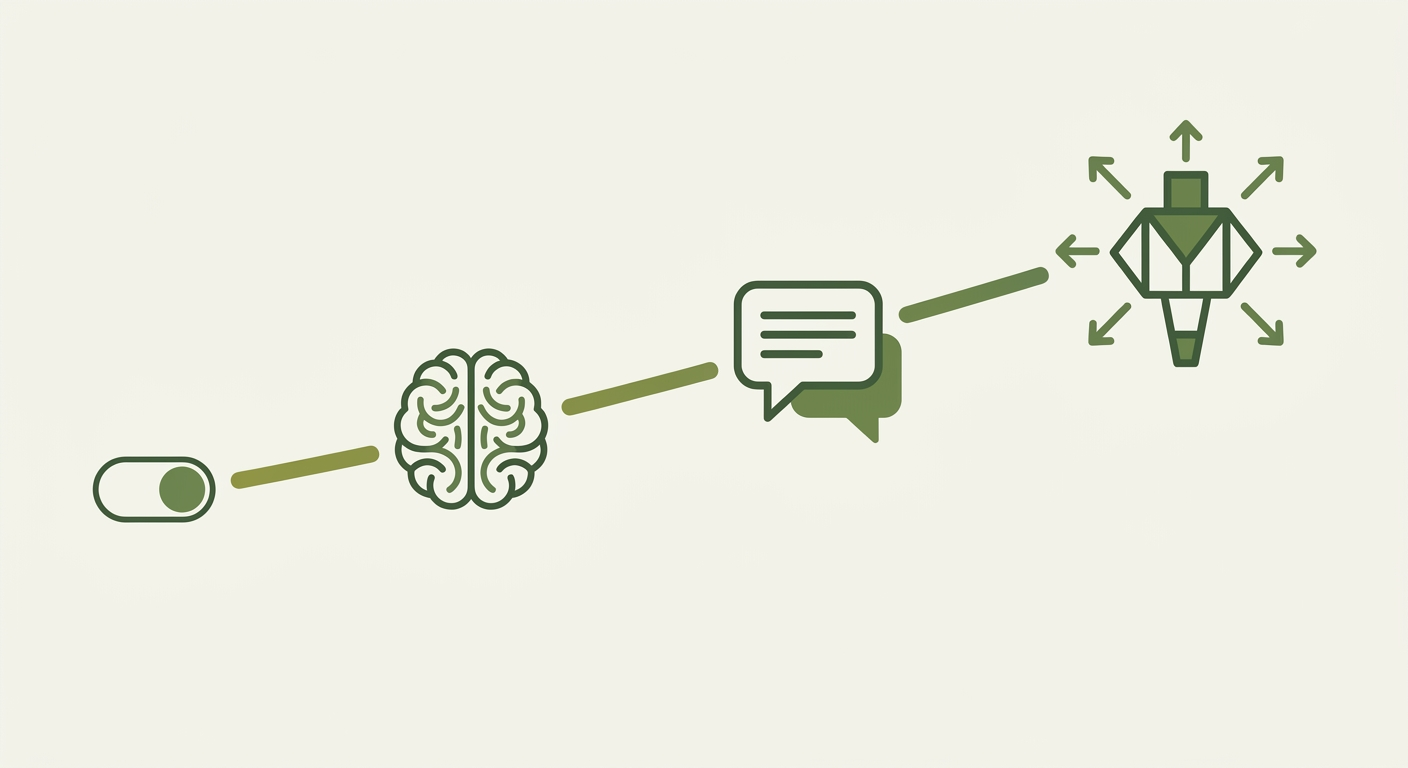
Simple Rules  →  Pattern Recognition  →  Language Understanding  →  Autonomous Action
(thermostat)     (spam filter)           (chatbot)                  (AI agent)
The Evolution of "AI"
The meaning of "AI" has shifted dramatically over time:
1950s-1980s: Symbolic AI
The original approach: program explicit rules. "If the opponent moves here, respond with this." These systems were logical but brittle — they couldn't handle situations the programmers hadn't anticipated.
1990s-2010s: Machine Learning
Instead of programming rules, you feed data to algorithms that learn patterns. A spam filter doesn't need rules about specific keywords — it learns what spam looks like from millions of examples. This was the shift from "telling the computer what to do" to "showing the computer examples and letting it figure out the pattern."
2010s-2020s: Deep Learning
Neural networks with many layers (hence "deep") achieved breakthroughs in image recognition, speech processing, and language translation. The key insight: given enough data and compute, these systems could learn incredibly complex patterns without being explicitly programmed for each one.
2023-Present: Generative AI and Agents
Language models like GPT-4 and Claude can write, code, analyze, and create. The latest evolution: agentic AI — systems that don't just respond to prompts but pursue goals autonomously, using tools like web search, code execution, and file management to accomplish multi-step tasks.
Types of AI
Narrow AI (What We Have Today)
AI designed for a specific task. ChatGPT can write essays but can't drive a car. AlphaGo can beat world champions at Go but can't summarize an email. Every AI system in production today is narrow AI — extremely capable within its domain, useless outside it.
General AI (What Researchers Are Working Toward)
AI with human-like flexibility across any intellectual task. A general AI could learn to drive, write code, compose music, and debate philosophy — not because it was trained on each separately, but because it can reason across domains like a human can. This doesn't exist yet, and there's no consensus on when (or if) it will.
Superintelligent AI (Theoretical)
AI that surpasses human intelligence in every dimension. Entirely theoretical and the subject of intense debate about risks and timelines.
How AI Relates to Other Terms
| Term | What It Means |
|---|---|
| AI | The broadest category — any machine that performs tasks requiring intelligence |
| Machine Learning (ML) | A subset of AI where systems learn from data rather than following explicit rules |
| Deep Learning | A subset of ML using multi-layer neural networks |
| Generative AI | AI that creates new content (text, images, code, music) |
| LLM (Large Language Model) | A type of generative AI trained on vast amounts of text |
| Agentic AI | AI systems that pursue goals autonomously using tools |
All LLMs are generative AI. All generative AI is deep learning. All deep learning is machine learning. All machine learning is AI. But not all AI is machine learning — some AI still uses rule-based systems.
What AI Means in Practice (2026)
In 2026, AI isn't a distant concept — it's infrastructure. Here's what it means for different groups:
For Developers
AI is a tool and a platform. You can use AI to write code (GitHub Copilot, Claude Code), build AI features into your products (APIs), and create autonomous agents that handle complex workflows (AnyCap).
For Businesses
AI means automation that was impossible five years ago. Customer support that actually understands questions. Document analysis at scale. Content generation that's indistinguishable from human work. The question has shifted from "should we use AI?" to "where should we apply it first?"
For Everyone Else
AI is increasingly invisible — embedded in the tools you already use. Your email client suggests replies. Your photo app finds specific images by description. Your search engine answers questions instead of just returning links. You interact with AI constantly, often without realizing it.
The Shift from "What AI Is" to "What AI Can Do"
The most important evolution in the meaning of AI isn't technical — it's practical. The conversation has shifted from definitions to capabilities:
Old framing: "AI is a technology that..."
New framing: "AI can now..."
This shift matters because it reflects reality. In 2026, AI is defined less by its architecture and more by what it enables: agents that research, create, and deliver. Systems that don't just answer questions but complete tasks. Tools that give individuals and small teams capabilities that previously required entire departments.
This is where AnyCap fits — not as "another AI tool" but as the capability layer that turns language models into agents that can actually do things in the world. Search the web. Generate images. Store files. Publish pages. The AI thinks; AnyCap gives it hands.
To understand how AI actually works under the hood — the mechanics, not just the meaning — see our guide on how AI works.
Next: Dive into the mechanics of machine learning and neural networks in how does AI work.